

The initial stage of the 2025 NBA playoffs has already delivered numerous exciting moments, intense overtime battles, and standout individual performances. These serve as a powerful reminder of how minor details can ultimately determine the outcome of a best-of-seven series.
There`s no clearer illustration of this than Aaron Gordon`s game-winning buzzer-beating dunk in Game 4 of the hard-fought series between the Denver Nuggets and the LA Clippers. Analyzed frame by frame, the margin was incredibly narrow as the ball left Gordon`s hands just before the clock expired. This single play could potentially be the deciding factor in a series where the Nuggets currently hold a 3-2 advantage.
Considering the limited number of games played over the first two weeks of the postseason, the trends observed in the first round are likely not sustainable in the long term. Nevertheless, it`s valuable to examine whether these early patterns could influence the series that are still undecided, particularly the crucial Western Conference matchups scheduled for Wednesday.
Are the Minnesota Timberwolves` strong finishes in close games genuine? Is the Houston Rockets` success with a lineup featuring two centers a legitimate advantage? The answers to these questions could determine if the Los Angeles Lakers can force a Game 6 against Minnesota and if the Golden State Warriors can eliminate Houston.
Let`s analyze the data to distinguish which of these initial playoff takeaways appear to be real and which are probably not.


Trend: Timberwolves Excelling in Crunch Time
Minnesota`s struggles in winning close contests were a significant factor in why they had to fight to avoid the play-in tournament, despite having the second-best point differential (plus-5.0 PPG) in the Western Conference. The Timberwolves finished the regular season with a 20-26 record in games defined as “clutch” by NBA advanced stats (within five points in the final five minutes of regulation). Their net rating of minus-8.4 in these situations was better than only two other playoff teams, the Detroit Pistons and Miami Heat.
Given this history, close games in the matchup against the Lakers were expected to favor Los Angeles. The Lakers held a 23-16 record in clutch games, securing the No. 3 seed in the West despite having only the conference`s eighth-best point differential. However, after the teams split two lopsided games in Los Angeles, Minnesota surprisingly outperformed the Lakers by 14 points in clutch situations during their two close home victories, pushing the Lakers to the brink of elimination.
By their nature, clutch situations within a single series are heavily influenced by small-sample randomness. Despite Anthony Edwards` efforts down the stretch, the Timberwolves` most effective scorer on field goals in these moments has been center Naz Reid, who has made all three of his 3-point attempts. This specific detail provides little insight when looking ahead to a potential second-round series where Minnesota would hold home-court advantage if the No. 7 seed Warriors also advance.
Within the context of this specific series, however, the Lakers` difficulties in crunch time seem less random and more connected to fatigue. Los Angeles` successful formula since adding Luka Doncic has typically involved him controlling the first three quarters, allowing LeBron James to take charge in the final minutes. In Game 3, Doncic`s illness disrupted this plan, forcing James to carry too much of the offensive load early on.
During Sunday`s Game 4, Lakers coach JJ Redick evidently felt he couldn`t rely on his bench players for even a minute in the second half, keeping the same five players on the court. Both scenarios resulted in James being visibly exhausted during the closing minutes. In Game 3, the Lakers managed just one point (a free throw) over the final 4½ minutes. While role players Dorian Finney-Smith and Rui Hachimura hit a couple of late 3-pointers in Game 4, both Doncic and James were scoreless over the final five minutes, missing all four of their shots.
Had one or two plays unfolded differently on Sunday, the Lakers might have secured a win, and they could still potentially win a clutch game on Wednesday to extend the series. However, the Timberwolves` superior depth appears to give them an advantage in close games, effectively neutralizing a factor the Lakers had previously relied upon.
Verdict: Real for this series, not real beyond


Trend: Double-Big Lineup Causing Problems for the Warriors
After occasionally pairing 6-foot-11 centers Steven Adams and Alperen Sengun over the first three games against the Warriors, the Rockets fully committed to the double-big lineup in Monday`s Game 4. Adams and Sengun played 23 minutes together, their most extensive time on the court as a duo this season, and the Rockets significantly outscored the Warriors by 18 points during that span.
Warrior coach Steve Kerr`s only apparent counter in Game 4 was to deliberately foul Adams, a player who shot just 46% from the free-throw line during the regular season. Instead of allowing the Warriors to test Adams at the line as they did in Saturday`s Game 3, Houston coach Ime Udoka removed him from the game, and he did not return until the final two minutes when intentional fouls away from the ball result in harsher penalties.
Looking ahead to Wednesday`s Game 5, it`s reasonable to anticipate seeing more of Adams and Sengun playing together. However, expecting the same level of Rockets dominance when they do might be unrealistic. While Houston has consistently overwhelmed Golden State on the offensive boards throughout the series with Adams and Sengun (rebounding over half of their team`s misses when both are on the court), the results on Monday were significantly boosted by unusually hot shooting. The Rockets converted an impressive 7-of-9 attempts (78%) from 3-point range with the double-big lineup, while the Warriors struggled, shooting just 6-of-23 (26%) against Houston`s frequent zone defense.
From Golden State`s perspective, future matchups might be a greater concern. Houston`s decision to play Adams and Sengun together is partly a consequence of how ineffective their more conventional lineups have been; Jalen Green, for example, has scored in double figures only once in four games (which, not coincidentally, was Houston`s only win). Udoka had only used his two centers together for more than a single possession just once prior to March.
If both Golden State and Minnesota advance, the Timberwolves` pairing of Rudy Gobert and Naz Reid offers similar size but with better floor spacing and more experience playing alongside each other. And should Golden State reach the conference finals, the Oklahoma City Thunder`s starting frontcourt of Isaiah Hartenstein and Chet Holmgren could potentially expose Golden State`s lack of size and defensive rebounding prowess for much longer periods than the Rockets have.
Verdict: Not real this series, real beyond

Trend: Nikola Jokic and Other Stars Logging Heavy Minutes
JJ Redick is not the only coach in the first round hesitant to trust his bench players. With Russell Westbrook unavailable for Saturday`s Game 4, Nuggets interim coach David Adelman played his starters for at least 42 minutes. Both Nikola Jokic and Christian Braun remained on the court for the entire second half. This was the second time Jokic has played the entire second half in this series, already matching the number of times he did so during the Nuggets` entire 2023 championship run.
More broadly, eight players across the league are averaging at least 40 minutes per game in the first round so far, with four Nuggets players (Braun, Gordon, Jokic, and Jamal Murray) averaging 39.1 minutes or more. In an era where star players` minutes are often carefully managed, this statistic is particularly striking. First-round playing time hit a low point between 2016 and 2020, with only 10 total series during that period where a player averaged at least 40 minutes. (LeBron James accounted for three of those instances, Paul George for another three, Giannis Antetokounmpo for two, and two other players once each.)
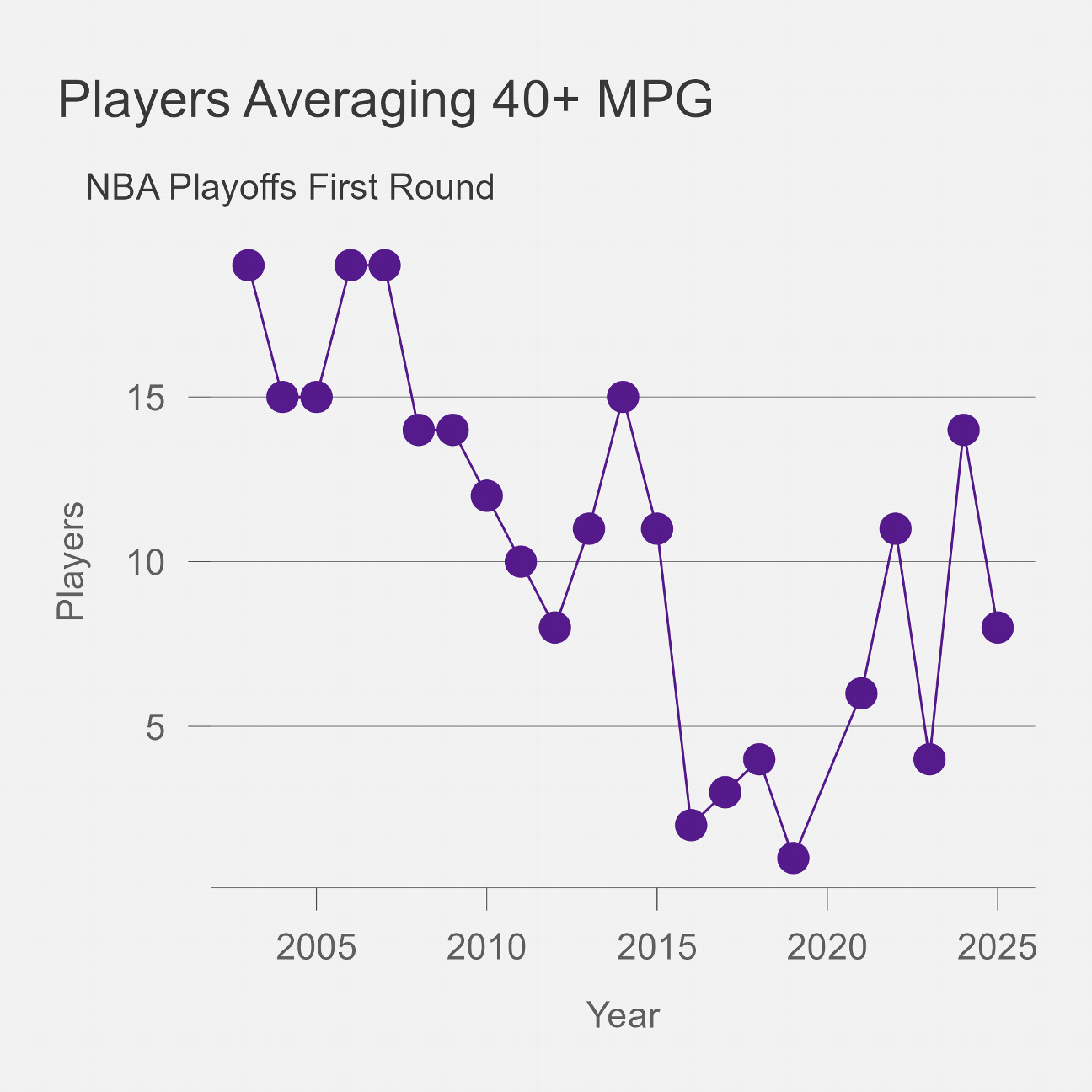
However, we have seen an increase in recent years. During the 2024 first round, 14 players averaged 40 minutes or more, the highest number in a decade. To some extent, the strategy of limiting minutes during the regular season is designed to allow players to increase their workload in the playoffs when the stakes are highest. Nevertheless, averaging over 40 minutes per game over an extended playoff run presents a significant physical challenge.
Since 2018, only three players who averaged over 40 minutes in the first round saw their teams reach the NBA Finals. All three teams ultimately lost in the Finals: Devin Booker with the 2021 Phoenix Suns, Jayson Tatum with the 2022 Boston Celtics, and Luka Doncic with last year`s Dallas Mavericks. The last player on an eventual championship team to average at least 40 minutes in the first round was LeBron James in 2016.
This trend bodes well for teams like the Thunder and Cleveland Cavaliers, who were able to sweep their opponents and avoid heavy minute loads for their stars. Shai Gilgeous-Alexander led Oklahoma City with an average of 35 minutes, and no Cleveland player averaged more than 31.3 minutes.
Verdict: Real, but worrisome

Trend: Boston`s Three-Point Frequency Has Decreased
After setting an NBA record by attempting 48 three-pointers per game during the regular season, the Boston Celtics currently rank 11th among the 16 playoff teams in the first round, attempting 33 threes per game against the Orlando Magic.
Utilizing their agile big men and physically capable guards, the Magic have been comfortable executing switches on pick-and-rolls and defending one-on-one. This strategy keeps their help defenders in place, preventing them from rotating towards Boston`s dangerous perimeter shooters.
The Celtics still rank fifth in pull-up 3-point attempts (12.5 per game), according to GeniusIQ tracking. However, their 20 catch-and-shoot attempts per game are tied for the third lowest among playoff teams, a significant drop from their regular-season average of 30.7.
While Orlando`s struggling offense was unable to capitalize, could the way the Magic defended Boston serve as a blueprint for future opponents? The answer is both yes and no. The downside of Orlando`s defensive approach is that the Magic, one of five teams to average at least 20 fouls during the regular season, have sent the Celtics to the free-throw line frequently. Boston`s 26.3 free throw attempts per game lead all teams in the playoffs so far, a notable increase from their league-low regular-season average of 19.1.
Consequently, simply limiting three-point attempts has not shut down Boston`s offense, which continues to score at the sixth-highest rate on a per-possession basis. Given that Orlando boasted the NBA`s second-best defensive rating in the regular season, this is a solid offensive performance by the Celtics. Furthermore, not every team possesses the personnel required to switch on pick-and-rolls as frequently as the Magic have (46% of the time, according to GeniusIQ) without creating unfavorable defensive matchups.
The New York Knicks and Cleveland Cavaliers, the Celtics` most likely remaining opponents in the conference, have smaller guards who might struggle defending players like Jaylen Brown, Kristaps Porzingis, and Jayson Tatum one-on-one. The Knicks would also be hesitant to leave Karl-Anthony Towns isolated defensively against Brown or Tatum.
The team arguably best equipped to replicate the Magic`s defensive strategy is the only team that had a better regular-season defensive rating: the Oklahoma City Thunder. However, Oklahoma City has employed the opposite strategy. Thunder opponents attempted three-pointers at the league`s highest rate, including 109 attempts by Boston in their two regular-season meetings. Despite the high volume, the Celtics only made 27% of those threes, as Oklahoma City swept the season series.
Verdict: Not real

Trend: OKC Concerned About Shai Gilgeous-Alexander`s Slow Offensive Start
After scoring 18 points on October 30 in a win against San Antonio, Shai Gilgeous-Alexander proceeded to score at least 20 points in the remaining 75 games of the regular season. Only Wilt Chamberlain (80 games, twice) and Oscar Robertson (76 games) have achieved longer single-season streaks. In this context, it was noteworthy that the MVP front-runner had a relatively quiet offensive output over the first three games of the Thunder`s first-round sweep of the Memphis Grizzlies.
Gilgeous-Alexander finished with just 15 points in 23 minutes during Oklahoma City`s dominant 51-point victory in Game 1. While he combined for 58 points over the next two games, this came on an unusually inefficient 20-of-55 shooting (36%). It wasn`t until Game 4 that Gilgeous-Alexander scored efficiently, putting up 38 points on 13-of-24 shooting and adding 11 free throws.
Memphis guard Scotty Pippen Jr. deserves credit for his defensive effort on Gilgeous-Alexander. On 25 shots where Pippen was the primary defender, Gilgeous-Alexander`s quantified shot probability (qSP), which estimates the expected effective field goal percentage based on shot type, location, and defender distance, was only 49.5%. This is lower than his 54% qSP during the regular season, according to GeniusIQ.
On all other shot attempts in the series, Gilgeous-Alexander`s qSP remained consistent with his regular-season mark at 54%. However, he actually shot an effective 45% on those attempts, suggesting some uncharacteristic misses.
Overall, Gilgeous-Alexander made just 16 of 53 shots (30%) from outside the paint in the first round. He converted these shots at a 43% rate during the regular season. Based on these numbers, there appears to be no significant reason for concern regarding his scoring ability as the Thunder advance to the second round and beyond.
Verdict: Not real