
MADRID — Recognizing opportunities, Aryna Sabalenka executed a beautiful drop shot winner to conclude the first game against Anna Blinkova on Friday. The second game finished in the same manner. A surprising serve-and-volley tactic secured Sabalenka a fifth consecutive game.
Variety is clearly becoming a part of Sabalenka’s powerful playing style. This evolution is a primary factor in her ascent to the No. 1 spot in the PIF WTA Rankings.
Looking ahead, these subtle yet increasingly impactful additions – particularly her more frequent approaches to the net and increased use of drop shots – will be key elements of her game at the Mutua Madrid Open. Sabalenka defeated qualifier Blinkova 6-3, 6-4 and is set to face No. 28 seed Elise Mertens on Saturday.
“I think maybe on clay it’s a bit easier because the game overall is a bit slower,” Sabalenka mentioned during her pre-tournament press conference on Wednesday. “You have extra time.”
However, a conflicting thought then occurred to her.
“I don’t know, at the same time it’s easier and harder because I have more time and I have more options in my head,” Sabalenka said with a laugh, “and sometimes I get confused.”
Sabalenka, holding a significant lead in the rankings and the Race to the WTA Finals, is arguably the top player on the Hologic WTA Tour currently. Yet, she admits she`s still refining how to integrate diversity into an approach that historically relied heavily on sheer power.
“It’s a learning process and I’m not afraid to make mistakes,” Sabalenka stated. “I think with time I will learn how to make the right decisions. It’s going to benefit my game. I think on the clay court, it’s like a good practice with those shots.”
“You just have to make sure you pick the right one at the right moment.”
Strategic Advancements
Last fall at the WTA Finals, Sabalenka’s coach, Anton Dubrov, discussed their pursuit of new tactics.
“We’re trying,” he said, “to find somewhere we can be better.”
This has been an ongoing effort.
Just two years ago, double faults significantly impacted Sabalenka’s season. She recorded a WTA Tour-high 428 in 2022, resulting in a minus-179 ratio factoring in aces. By adding biomechanic specialist Gavin MacMillan to her team, this issue was resolved.
In 2023, her ratio improved dramatically to plus-119 (404 aces vs. 285 double faults). This coincided with her winning her first Grand Slam singles title in Melbourne and securing three of the last five hard-court majors.
And now, the latest strategic focus is on moving forward on the court.
Dubrov acknowledges the common advice he hears.
“Everyone can say, ‘Oh, yeah, she’s got to finish on the net,’” Dubrov remarked. “That’s good advice, like, ‘Don’t do double faults.’ That’s also great advice.”
However, execution is far more complex than simple advice.
“It’s got to be at the right time,” Dubrov explained. “What is the structure of the point? Within your mind, you have to finish the point at net.”
Consider this data on her net approaches heading into the clay season:
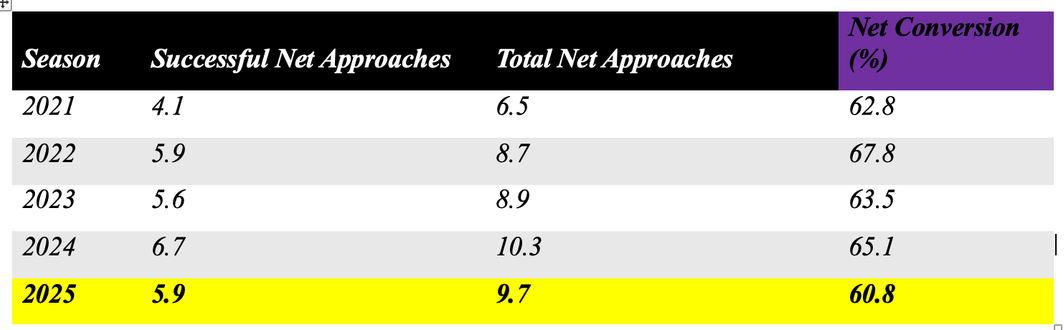
Dubrov noted the significant jump in Sabalenka’s net approaches from 2021-2024, calling it “a big jump.”
While 2025 data is still limited, in 2024, only three players had more successful net approaches than Sabalenka. Other players known for effectively coming to net include Elena Rybakina, Beatriz Haddad Maia, Jasmine Paolini, and Coco Gauff.
Variety Enhances Power
This trend of moving forward is welcomed by Martina Navratilova.
The legendary 18-time Grand Slam singles champion was a pioneer of aggressive net play in women’s tennis. She often expresses frustration when powerful players don`t capitalize on their strength by finishing points quicker at the net, citing top players like Iga Swiatek and Sabalenka.

How crucial is it that Sabalenka is adding these new elements to her game?
“It’s huge,” Navratilova stated, “because the margins are so small. By not moving forward you’re allowing the other player to get back into the rally. And then you have to start over. You are improving the odds of winning the point by moving forward and hitting the right shot — and, therefore, improving your odds of winning the match. Every little bit helps.”
“Whether you make the shot or not — you’re trying. But moving forward or not, that’s a choice. Sabalenka’s volley has gotten better. She’s got more variety. It’s great to have that much power, but when you add variety to it — that power pays off even more.”
Jessica Pegula, who faced Sabalenka in the Miami Open final, has also observed this change.
“She’s moving a lot better, and I think being a little bit more creative on court,” Pegula commented. “So all of a sudden, it’s not just her power, it’s a lot of these other things that she’s doing better that maybe used to be weaknesses. So I think she’s just all around has stepped up a lot of things.”
Like Sabalenka, Carolina Garcia is a powerful player known for aggressive play. She believes modern fitness levels allow players unprecedented court coverage. Garcia notes that the sheer force of shots from players like herself and Sabalenka often results in shorter replies, creating opportunities to approach the net and finish points.
“It’s quite useful to go to the net because you are winning a lot of time on your opponent,” Garcia said. “And sometimes it’s a little bit easier because the ball will be a little higher to the net, so it’s easier to finish. Rather than when you have to let it bounce — and then the ball goes slowly again and you have to use the power and your risk gets a little bit more.”
“So it’s always quite a good way to finish the point.”
Expect to see this strategy utilized even more in the future.
“It’s still in process,” Dubrov said, estimating her proficiency at “like 50, 60 percent. It’s not there yet. But if you can add, say five percent [more approaches] every half year, it’s huge.”
Mastering the Drop Shot
After winning the Wuhan title last year, her third consecutive win there, Sabalenka spoke about her evolving game.
“I improved a lot,” Sabalenka stated. “I can come to the net and I can finish point and then I can use my touch. I got some variation in my pocket. I just kept telling myself that if you’re not going to be able to hit the ball or slice, hit drop shot, come to the net.”
“I was just reminding myself that I have a lot of weapons, not only hitting the ball.”
Sabalenka mentioned she could execute the drop shot in practice, but integrating it effectively into match play was the challenge. Last year, during a match against Elina Svitolina in Rome, already dealing with a shoulder injury that would later lead her to miss Wimbledon, she used the drop shot out of necessity.
“The only option for me was to finish the point as soon as possible,” Sabalenka recalled in Madrid. “I was like, ‘You know what, I’m going to go for the drop shots.’ I think the best training is training on the match. After that match I was like, ‘Oh, actually it’s working, probably we have to work on that shot more often.’”
“Five years ago if someone will tell me I will finally learn how to do this shot, I’ll be like laughing. I don’t have touch. I’m so bad at it. Now I have this shot in my pocket.”
The element of surprise is a significant advantage, especially at the elite level. In tennis, hitting a serve wide when down the middle is expected, or going crosscourt instead of down the line, can be decisive. So, when Sabalenka`s powerful shots force opponents far behind the baseline, she now has another tactical option.
“When I see the opponent is really way far behind,” Sabalenka explained, “I’m like, ‘OK, I’ll just make them move.’ I’m really happy that finally, finally I learned this shot.”
“I kind of have control, which is crazy to say, to be honest. Yeah, that’s just good to have, isn’t it for me? For me, not for my opponent.”