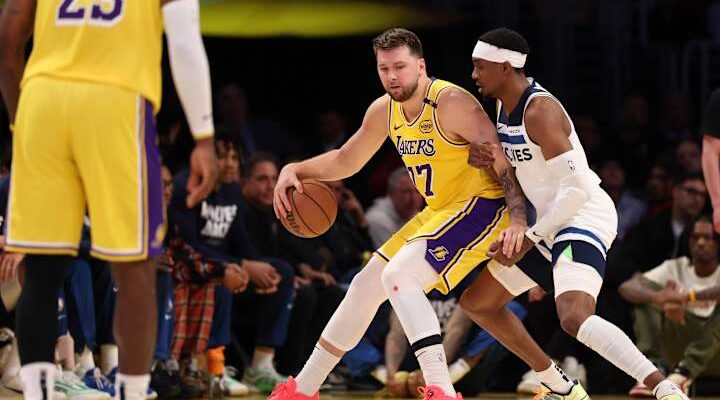
SO MUCH WENT wrong for the Los Angeles Lakers in their initial playoff loss (117-95) to the Minnesota Timberwolves that pinpointing a single main problem was difficult. The Timberwolves were highly effective from the three-point line, setting a franchise playoff record with 21 made threes. They significantly outperformed L.A. in transition scoring, 25-6. Additionally, the Lakers` offense, which was reasonably strong during the regular season (ranking 11th), faltered late in the game, scoring only 17 points in the fourth quarter. Key players struggled, with Luka Doncic recording just one assist (far below his average) and LeBron James scoring only 19 points (also below his average).
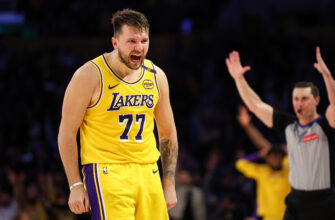
Just minutes into the second game of the series on Tuesday, the Lakers began to make adjustments, partly through a signature play executed by their two stars. The sequence started when Minnesota forward Jaden McDaniels missed a corner three-pointer, with Austin Reaves closing out strongly to contest. Lakers forward Rui Hachimura secured the rebound and advanced the ball to Doncic on the right side. By the time Doncic received the pass in the backcourt, slightly behind the three-point line, James was already sprinting ahead into the frontcourt. Only Wolves point guard Mike Conley was positioned to defend James as he drove towards the basket.
Doncic took one dribble and turned upcourt when he spotted James. Seizing the opportunity, Doncic immediately launched a fifty-foot outlet pass that arced over Conley`s head and landed perfectly into James` hands, setting up an easy point-blank shot that went in.
“It`s easy,” Doncic told reporters after the game. “I know what he`s going to do. He`s going to beat his defender and I just throw it up there. It`s not hard.”
That score put L.A. ahead 7-4 early in the first quarter and foreshadowed the Lakers` subsequent adjustments. Doncic finished the game with nine assists, the Lakers reversed the fast-break scoring differential (outscoring Minnesota 13-6), and L.A. won the game 94-85, tying the series at one game each.
As the series moves to Minneapolis for Game 3 on Friday, facing the Wolves` sixth-ranked defense, the connection between Luka and LeBron will be more than just a useful tactic for the Lakers` offense. It demonstrates the dangerous alliance the pair has already established, which they hope will contribute to a deep championship run.
“One thing about Luka,” James said, “you got to be at the right spot at the right time or you got to make the connection, or he won`t pass you the ball like that. So, I think he trusts me.”
DONCIC AND JAMES first showed their fast-break chemistry in their debut game together for the Lakers, a 132-113 victory over the Utah Jazz on February 10th. With the Lakers holding a twenty-point lead late in the second quarter, James ran to contest a three-pointer by Lauri Markkanen, then continued sprinting past him towards the other basket. After the miss, Doncic grabbed the rebound near the paint, took one dribble up the court, and delivered a pass approximately sixty-five feet to find James in full stride for a layup.
After scoring, James acknowledged his new teammate by raising his left hand and pointing his index finger towards him as he transitioned back to defense.
Lakers coach JJ Redick commented on the early signs of chemistry between the two. “I think instantly you saw just the ability to feed off each other in transition, particularly with Luka as an outlet passer, LeBron running or getting down the court and creating an early cross match and getting that early seal,” Redick said. “We saw that sort of right away.”
Such plays, and the understanding required, have been part of the veteran James` game throughout his 22-year career.
“If you watch Bron`s career, whenever he had great passers who can make that pass — Kevin Love, Dwyane Wade — it was always effective,” Lakers forward Dorian Finney-Smith observed. “Bron does a good job of reading those [passes]… I think that`s definitely an advantage and gives us easy points. It`s hard to get easy points in the league.”
Lakers guard Gabe Vincent agreed, stating, “Great players got to get easy buckets too. Sometimes, that`s the easiest shot that he`s going to get [all game].”
In the 21 games they played together before the playoffs began, Doncic connected with James for five assists specifically from passes that traveled sixty feet or more, according to tracking data. This was the highest number of such long-distance assists between any two players in the league during the final two months of the regular season.
James continues to defy the usual expectations for an aging NBA player, but his approach in 2025 is different from his twenties. His initial burst off the dribble isn`t as explosive as it once was, and he can no longer simply leap over defenders to finish as easily. In the first two games against Minnesota, opponents like Julius Randle and Rudy Gobert have done a respectable job containing him in half-court situations.
However, James` strategic understanding of the game is as sharp as ever. In 2018, he admitted to conserving energy throughout a game by identifying possessions where a teammate could handle the offense, allowing him to exert more energy on defense.
Playing the role of a “wide receiver” to Doncic`s “quarterback” is the latest evolution in his game plan.
When asked before the playoffs about the key to his chemistry with Doncic, James credited his 26-year-old teammate.
“Offensively? Give Luka the ball,” James said. “If we stay ready, we never got to get ready.”
WHEN THE WOLVES prepared to face the Lakers on February 27th, the first time after L.A. acquired Doncic, Minnesota coach Chris Finch considered how challenging James would still be even without dominating the ball.
“If you`re overhelping in the gaps, you`re going to open massive runways for him to get downhill. That`s not going to end well for a defense, generally,” Finch stated before that game. “We spent a lot of our coaches` meeting talking about LeBron [playing] off ball and what that does to a defense… It`s a whole `nother threat level.”
The Lakers won that night, with James scoring 33 points on 11-of-21 shooting and six assists. Doncic contributed 21 points on 6-of-20 shooting with five assists, while Austin Reaves added 23 points and five assists.
When Minnesota secured the sixth seed and their first-round matchup against L.A. was confirmed, a specific goal of the Wolves` strategy, according to sources, was to limit James` effectiveness in transition. The belief was that forcing him to work predominantly in half-court sets could wear him down over a potentially long series.
Through the first two games, this effort has been somewhat successful. The single outlet pass from Doncic accounts for James` only two transition points of the series so far. This is a significant decrease from his regular-season average of 6.0 transition points per game, which ranked sixth in the NBA.
Sources compared the Wolves` defensive strategy to a mix of man and zone coverage in football. After a Minnesota miss, two players are instructed to quickly retreat defensively. One defender is specifically assigned to guard James man-to-man. Simultaneously, the players who crashed the offensive glass are told to immediately pressure Doncic if he secures the rebound, preventing him from having a clear window to launch long passes for fast breaks.
Despite these efforts, Coach Finch is unlikely to be relaxing. The Lakers haven`t even fully utilized the scenario where James acts as the “quarterback” throwing to Doncic yet this series.
“Passing to each other, them two? It sounds crazy to even be saying that,” Finney-Smith remarked about the duo. “Two years ago, that would have sounded fake. What am I saying — two years ago? Two months ago it would have sounded fake.”