
The Stanley Cup playoffs consistently provide valuable insights, whether derived from moments of significant success or disappointing failure.
Sometimes these lessons prove enduring. Other times, they are quickly forgotten. And occasionally, as the postseason progresses, entirely new takeaways emerge.
Here are eight key observations from the 2025 Stanley Cup playoffs, covering the action through Monday night.
- The Maple Leafs Show Stanley Cup Potential
- Is High Scoring the New Playoff Normal?
- Mikko Rantanen Proves His Value
- The Strange Formula for Game 7 Comebacks: Missing Key Players
- History Repeats: The Fourth Time Is *Not* Always the Charm
- The Reign of Super Mega Lines
- Regular Season Accolades Don`t Guarantee Playoff Success
- The Capitals` Front Office Continues to Impress
The Maple Leafs Show Stanley Cup Potential
Yes, I`m referring to their potential to win the actual Stanley Cup. Why the surprise?
Ah, right, because it`s the Toronto Maple Leafs. They haven`t competed for the Cup since their last championship in 1967, a span of 56 years. They haven`t reached the conference finals since 2002. There`s a long-standing joke that the Stanley Cup is perfectly safe in the Hockey Hall of Fame because no one in Toronto will ever hoist it.
Every Maple Leafs playoff team seems burdened by half a century of unmet expectations and a tendency for self-sabotage. Their most challenging opponent often appears to be themselves, allowing doubt to derail their aspirations for a championship.
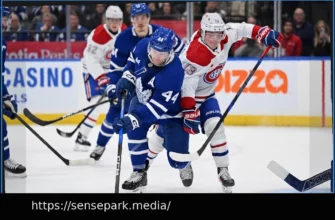
So, what are we to make of a Toronto team that isn`t letting these historical issues take hold? This current squad hasn`t. They`ve secured five wins in seven games across the first two rounds. Their key players, dubbed the `Core Five` (the original `Core Four` of Auston Matthews, Mitch Marner, William Nylander, and John Tavares, plus Matthew Knies), are delivering crucial performances in high-pressure situations. Above all, this team seems to possess the mental fortitude instilled by coach Craig Berube, and his methods are yielding tangible results.
When the St. Louis Blues won the Stanley Cup under Berube in 2019, they were perhaps one of the most mentally resilient teams to achieve the feat. They recovered from being last in the league in early January and successfully navigated various challenges and controversies on their path to the championship, truly embodying the idea of overcoming adversity.
As assistant coach Larry Robinson put it in 2019: “We were counted out many times throughout the year, and each time we responded. We faced adverse calls in games. While many teams would panic and make errors, this group showed immense willpower and heart.”
When Toronto hired Berube, part of the appeal was his ability to bring that calm, playoff focus to a franchise known for panic and mistakes. This theory was tested in the first round, and the team held firm: the old Leafs might have panicked after losing Game 5 at home, dropped Game 6 in Ottawa, and then faced a deciding Game 7 back in Toronto, leading to maximum fan anguish. Instead, this team won Game 6 convincingly, closing out the series.
In Game 1 of the second round against Florida, they built leads of 2-0 and then 4-1, saw the opposing goalie leave due to injury, and watched the Panthers rally—only to successfully hold on for the win.
Perhaps this version of the team is fundamentally different. Maybe the difficult lessons from past playoff failures have finally taught the Core Five how to win. Perhaps they have the right coach to reinforce those lessons and maintain composure when facing pressure.
It`s possible the Toronto Maple Leafs are genuinely contenders for the Cup.
Or perhaps I will deeply regret making this declaration by Game 6 of their series against Florida.
Is High Scoring the New Playoff Normal?
When you envision a Game 7 in the Stanley Cup playoffs, what kind of score do you picture? A tightly contested game with limited scoring opportunities? A defensive battle where goaltenders are the ultimate difference-makers in a 2-1 thriller, with penalties only called for clear rule violations (like icing the puck over the glass or having too many men) or something resembling illegal activity?
Yet, the Game 7 between the Dallas Stars and Colorado Avalanche ended 4-2. And the Game 7 between the Jets and Blues finished 4-3, despite requiring two overtimes.
This is indicative of a broader trend observed in these playoffs. Across the 47 first-round games, 307 goals were scored, resulting in an average of 6.53 goals per game. If this average persists through the remaining rounds, the 2024-25 postseason would be the highest scoring since the 1992-93 season (6.84 goals per game).
If the goals-per-game average stays above six, it would mark the third time this threshold has been met in the last four postseasons. Again, one would have to go back to the 1992-95 period to find a similar multi-year scoring trend. In fact, the NHL experienced a 26-season stretch (1995-2022) without a playoff average of six or more goals per game.
Scoring has notably increased across the NHL over the past eight seasons. Even with minor year-over-year declines in the last two seasons (from 6.36 goals per game in 2022-23 to 6.08 this regular season), the league average has exceeded six goals per game in six of the last seven seasons, with only a slight dip during the shortened 2020-21 COVID season (5.87).
One factor contributing recently: power plays remain highly effective. This season`s conversion rate was 21.6%, ranking ninth best all-time and the highest since 1985-86 (22.2%). The NHL`s league-wide power play success rate has been over 20% in six of the past eight seasons.
The conversion rate in the first round of these playoffs reached 24.9%. This is up from 20.6% during the entirety of last year`s postseason. Again, this continues a multi-year trend: after having only one Stanley Cup postseason with a power play conversion rate above 20% in a 36-season span (1983-2020), the NHL has now seen rates higher than 20% in five consecutive postseasons.
The perception that playoff hockey is fundamentally different from the regular season is difficult to change. However, the statistics so far suggest that the regular-season trend of increased scoring has, at least temporarily, extended into the postseason.
Mikko Rantanen Proves His Value
Any future dominant performance by a player against their former team will likely be measured against Mikko Rantanen`s efforts in eliminating the Avalanche in the first round.
He racked up 11 points in the final three games of the series, two of which were victories for his Stars. In contrast, Martin Necas, the player acquired by Colorado from Carolina as a less expensive replacement, managed four points during that span and was held pointless in Game 7.
Rantanen is the first player in NHL history (regular season or playoffs) to record four-point periods in back-to-back games. He`s also the first player with 10 or more points over Games 5-7 of a series. Furthermore, he`s the first player to score a hat trick in the third period of a Game 7 and the first to achieve a hat trick against his former team in a Game 7.
He`s performing at an elite playoff level. He`s effectively the postseason MVP for Dallas so far. And quite frankly, he`s exactly the type of player the Avalanche could have desperately used in that series.
Regardless of whether Rantanen`s agent sought a contract too high for Colorado or if the Avalanche simply made a strategic `business decision` for greater salary cap flexibility with the hope of collectively replacing his production, the choice to trade Rantanen before free agency was Colorado`s. Had they not sent him to Carolina, he would have been playing on Nathan MacKinnon`s line in this very series. While it`s true some of Colorado`s subsequent trade deadline moves to improve their roster might not have occurred, Rantanen`s presence in Colorado instead of Dallas would have fundamentally changed the outcome of that series.
The Hurricanes aggressively pursued Rantanen when he became available, hoping to sign him long-term (which didn`t happen), but also valuing his reputation as a strong playoff performer. He entered this postseason with 101 points in 81 career playoff games, including 25 points in 20 games during the Avalanche`s 2022 Stanley Cup victory.
Credit is due to Carolina: over the past two seasons, they identified and acquired two difference-making playoff scorers who met expectations in Rantanen and Jake Guentzel (who was arguably Tampa Bay`s best player in their first-round loss to Florida). The challenge for the Hurricanes was their inability to retain either player; in Rantanen`s case, they didn`t even get to see him play for them in the playoffs.
The `Hockey Gods` provided the compelling storyline of Mikko Rantanen facing his former Avalanche teammates in the opening round, a player seemingly getting `revenge` against the team that moved on from him. Will they offer another fascinating narrative twist, presenting Rantanen against his *other* former team, Carolina, in the final round – a scenario where the Hurricanes could feel they`re gaining `revenge` against a player who departed?
One can never be certain with the `Hockey Gods.` They certainly possess a playful sense of humor.
The Strange Formula for Game 7 Comebacks: Missing Key Players
Admittedly, this observation is based on a very small sample size.
Yet, the Stars managed to rally from a two-goal deficit in the third period of Game 7 to eventually eliminate the Avalanche, doing so without the injured Jason Robertson (80 points) and top defenseman Miro Heiskanen (25:10 average ice time), neither of whom played in the series.
Subsequently, the Winnipeg Jets also overcame a two-goal third-period deficit in Game 7 to ultimately eliminate the St. Louis Blues. They accomplished this feat without injured Mark Scheifele (87 points), who missed Games 6 and 7, and defenseman Josh Morrissey (24:23 average ice time), who participated in only four shifts in the first period of Game 7 before leaving with a shoulder injury.
Apparently, being without two of your most critical players in the season`s biggest game is a predictor of positive outcomes.
Okay, I understand the alternative perspective: perhaps if those players had been available, a Game 7 wouldn`t have been necessary at all. This reasoning is somewhat like citing `Pete DeBoer`s 9-0 record in Game 7s` while overlooking his 7-15 record in Game 6s and 5-7 when holding a chance to clinch in Game 6. It focuses solely on the final result, not the journey.
However, I would counter that point with a touch of `Ewing Theory.` This concept, popularized by former ESPN writer Bill Simmons, suggested that teams featuring Basketball Hall of Famer Patrick Ewing – both Georgetown University and the New York Knicks – would `mysteriously perform better when Ewing was injured or sidelined by foul trouble for significant stretches.`
Naturally, the Ewing Theory doesn`t apply universally. The New Jersey Devils` swift five-game exit against Carolina without the injured Jack Hughes serves as a counter-example. But the theory isn`t solely about achieving success or failure without a star; it also highlights how other players respond and elevate their game in their absence. Consider Nico Hischier, who scored just two goals in his first 17 regular-season games but then tallied four goals in five playoff games against Carolina while Jack Hughes (and for four games, Luke Hughes) was out of the lineup.
Without Heiskanen, who typically matched up against Nathan MacKinnon`s line, the Stars relied on Cody Ceci and Esa Lindell to contain him in Game 7. MacKinnon scored once but was largely limited otherwise. In Robertson`s absence, Mikko Rantanen stepped up dramatically, contributing 11 points in the final three games of their series.
With Scheifele unavailable, captain Adam Lowry anchored the top line with Kyle Connor and Alex Iafallo for over 14 minutes in Game 7; they generated a 21-shot attempt advantage and collaborated on the double-overtime winning goal. Cole Perfetti scored three goals in Scheifele`s absence, two of them coming in Game 7.
Coach Scott Arniel commented on Perfetti`s performance, saying, “His goal in St. Louis was significant. Then he added two crucial ones tonight. That`s the kind of development you hope for. For someone without much playoff experience, his response in a very physical series was impressive.”
Without Morrissey, Winnipeg relied on just five defensemen. Neal Pionk and Dylan Samberg each logged over 44 minutes, and Haydn Fleury delivered an outstanding performance with 33:02 of ice time.
Arniel praised the defense, stating, “What a tireless effort from our defense. They were constantly switching partners. It was players stepping up when needed. That`s exactly what we required.”
Of course, getting their second-leading scorer and top defenseman back would undoubtedly be their preferred scenario. Perhaps that will happen in the second round…
History Repeats: The Fourth Time Is *Not* Always the Charm
There were valid reasons to anticipate the Los Angeles Kings finally defeating the Edmonton Oilers in the first round, despite having lost to them in the three preceding postseasons.
The Oilers had a defensively inconsistent season, relying on precarious goaltending, and were missing key defenseman Mattias Ekholm. Moreover, their superstar pairing, Connor McDavid and Leon Draisaitl, had both missed time due to injuries late in the regular season.
The Kings themselves seemed well-prepared to contain Edmonton, boasting the best regular-season goals-against average (2.48) and a Vezina Trophy finalist goaltender (Darcy Kuemper) entering the matchup. The previous playoff meetings between these teams had been exceptionally close: since 2023, 10 out of 12 playoff games were decided by a single goal or featured the game-winning goal scored in the third period.
Yet, the primary reason so many believed the Kings would finally defeat Edmonton – including 16 out of 26 ESPN analysts! – was the pervasive idea that the fourth attempt *had* to be successful. How could essentially the same two teams meet in the playoffs four consecutive years with one team winning every single time?
Well, history actually suggests this pattern isn`t unprecedented. Since 1968 (known as the `expansion era`), there has been only one other instance of the same two teams facing each other in the opening round for four straight seasons: Montreal vs. Boston from 1984 to 1987 – and Montreal emerged victorious in every single series.
But still, perhaps the fourth time *should* be the charm! Just look at the Buffalo Bills, who faced the Kansas City Chiefs four times in five postseasons… and lost every single time. Now, imagine instead of one Patrick Mahomes, you face two – that`s essentially the challenge the Kings faced in the Oilers` perennial MVP candidates, Draisaitl and McDavid.
It certainly didn`t help that after a promising start with two home victories, the Kings proceeded to commit a series of self-inflicted errors, highlighted by what was arguably the worst coaching performance in the first round by Jim Hiller. His unsuccessful coach`s challenge in Game 3 effectively handed Edmonton the win, resulting in a delay-of-game penalty after the Oilers tied the score 4-4, leading to their winning power play goal. His strategies of attempting to protect leads and not fully utilizing his depth players seemed like a defeatist approach against a team that excels at exploiting opponent weaknesses.
Nonetheless, given the current playoff structure, there`s always a next year. This time, it will be under new leadership, as this recent playoff failure resulted in Rob Blake losing his general manager position in Los Angeles.
The Reign of Super Mega Lines
Successfully winning the Stanley Cup typically requires contributions from every part of the lineup. Depth is often the deciding factor between hoisting the trophy and succumbing to playoff pressure.
That being said, it`s absolutely thrilling when teams opt to combine three exceptionally talented players to form a `Super Mega Line`.
The Vegas Golden Knights have assembled one featuring Jack Eichel, Mark Stone, and William Karlsson. Coach Bruce Cassidy deployed this line after winger Pavel Dorofeyev missed Game 6 due to injury, tasking this defensively responsible trio with handling Kirill Kaprizov`s line. They successfully limited and outscored Minnesota`s top offensive unit in the series-clinching game.
Eichel commented, “Everyone contributed at different moments in the series and found ways to make an impact. That`s what it takes to win at this time of year.”
Despite limited ice time together, the Golden Knights trio posted an impressive 67.7% expected goals percentage.
Stone and Eichel began to find their offensive rhythm late in the Minnesota series, recording points in each of the final three games, all of which were Vegas victories. Cassidy might keep them together with Karlsson to match up against either Connor McDavid or Leon Draisaitl – or perhaps even both if the Oilers reunite their stars. The Oilers, after all, are quite familiar with deploying their own dominant `Super Mega Lines.`
Regular Season Accolades Don`t Guarantee Playoff Success
When I speak of regular season awards, I`m not primarily referring to the Presidents` Trophy, which, as we all know, is widely considered cursed. Only eight teams finishing first overall in the NHL since 1986 have proceeded to win the Stanley Cup. The most recent instance was Chicago in 2013. Since then, and particularly since the NHL adopted a wild-card playoff format, no team that finished first overall has even reached the Stanley Cup Final, with two Presidents` Trophy winners being eliminated in the very first round.
Winnipeg, consider this a warning.
No, I`m focusing on individual NHL awards. Take Cale Makar, the strong favorite to win his second career Norris Trophy this season. His peers voted him the best overall defenseman (71.7%), and he earned a nomination for the Ted Lindsay Award.
Yet, where was that universally acclaimed player in the first round?
Makar`s stat line shows five points in seven games. However, three of those points came in Colorado`s high-scoring 7-4 Game 6 victory at home. He also recorded assists in the first two games. Crucially, he went pointless in four games against Dallas, including a noticeably subdued Game 7 performance where he was minus-1, took a late third-period tripping penalty, and registered only one shot on goal.
Dallas seemed to have a similar dampening effect on Makar last postseason, as he was held scoreless in three of their six games and managed only one assist and two shots in Colorado`s Game 6 defeat.
Before Game 6, Makar admitted, “I need to be significantly better. There have been moments where I`ve played well, but there`s much I can improve upon.”
Something was clearly not right with Makar`s game in that series.
Similarly, something has been consistently problematic for Connor Hellebuyck over *three* consecutive playoff series.
To be fair, he was solid in the third period and the two overtimes of Game 7 against St. Louis, helping to compensate for two questionable goals he allowed earlier in the game. However, that Game 7 only became necessary *because* of Connor Hellebuyck`s earlier struggles.
And that statement is not meant as a compliment. Had he performed even adequately in any of the three games in St. Louis, the Jets could have avoided Game 7 entirely. But he didn`t. He was exceptionally poor. He was pulled three times and finished the road games with a .758 save percentage and a 7.24 goals-against average. Over the last 40 years of Stanley Cup playoff history, this represents the worst road save percentage for any goalie facing at least 50 shots over a minimum of three road games.
Across the last three postseasons, Hellebuyck`s road record stands at 1-7 with an .838 save percentage and a 5.19 goals-against average.
Let me be clear, I am genuinely happy for Hellebuyck personally. This was a dreadful series for him, but he now has an opportunity against Dallas to repair his reputation and strengthen his case for the Team USA Olympic goalie spot by potentially outperforming Jake Oettinger, who is a very strong candidate himself and ready to claim that role.
But alongside that personal relief, his Game 7 victory, while a sigh of relief, means we won`t have to endure the extreme awkwardness of seeing a goaltender who significantly contributed to his team`s first-round exit for the third straight year potentially win the Vezina Trophy for best goalie for the second consecutive year – and possibly even the Hart Trophy as league MVP.
The Capitals` Front Office Continues to Impress
Consider the Washington Capitals` top 10 scorers after their first-round series victory against the Montreal Canadiens.
- Alex Ovechkin is prominently featured, the `Russian Machine,` who scored four goals in five games.
- Tom Wilson also contributed five points in five games, notable for a physical interaction on the bench with Josh Anderson, inspiring a viral crying meme, and delivering a hit on Alexandre Carrier that strongly resonated in Montreal.
- Connor McMichael also finished with five points in five games and a plus-5 rating.
Beyond these core players, the list of Capitals` top scorers comprises primarily acquisitions.
Dylan Strome (nine points) was acquired after leaving the Chicago Blackhawks. Anthony Beauvillier (five points) is with his sixth team in three years, joining Washington via trade from the Pittsburgh Penguins at the deadline. Brandon Duhaime was signed as a free agent and received a career-high average ice time of 13:21.
Jakob Chychrun and Pierre-Luc Dubois were acquired last offseason in `buy-low` trades, with Dubois` value significantly depressed due to his contract and disappointing tenure in Los Angeles. Andrew Mangiapane was another player brought in via trade. Trevor van Riemsdyk, a free agent signing in 2020, developed significantly within the Washington organization.
I have previously written about Washington`s impressive roster rebuild centered around Ovechkin, the skill of their front office, and the organization`s capability to develop and maximize talent. This has been clearly evident in their playoff performance so far and, frankly, is not receiving enough recognition.
The Capitals are widely viewed as significant underdogs against Carolina in the next round. However, these two teams appear far more evenly matched than the betting odds might suggest, especially with Washington holding home-ice advantage.
Capitals coach Spencer Carbery noted, “We are very familiar with their systems because we play a similar style. It essentially comes down to which team can execute it better and more consistently over the long run.”
Eastern Conference teams would be wise to underestimate the Capitals at their own peril. They possess depth, strong team chemistry, reliable goaltending, and, when all else fails, the greatest goal scorer in NHL history leading their power play.